 Steff
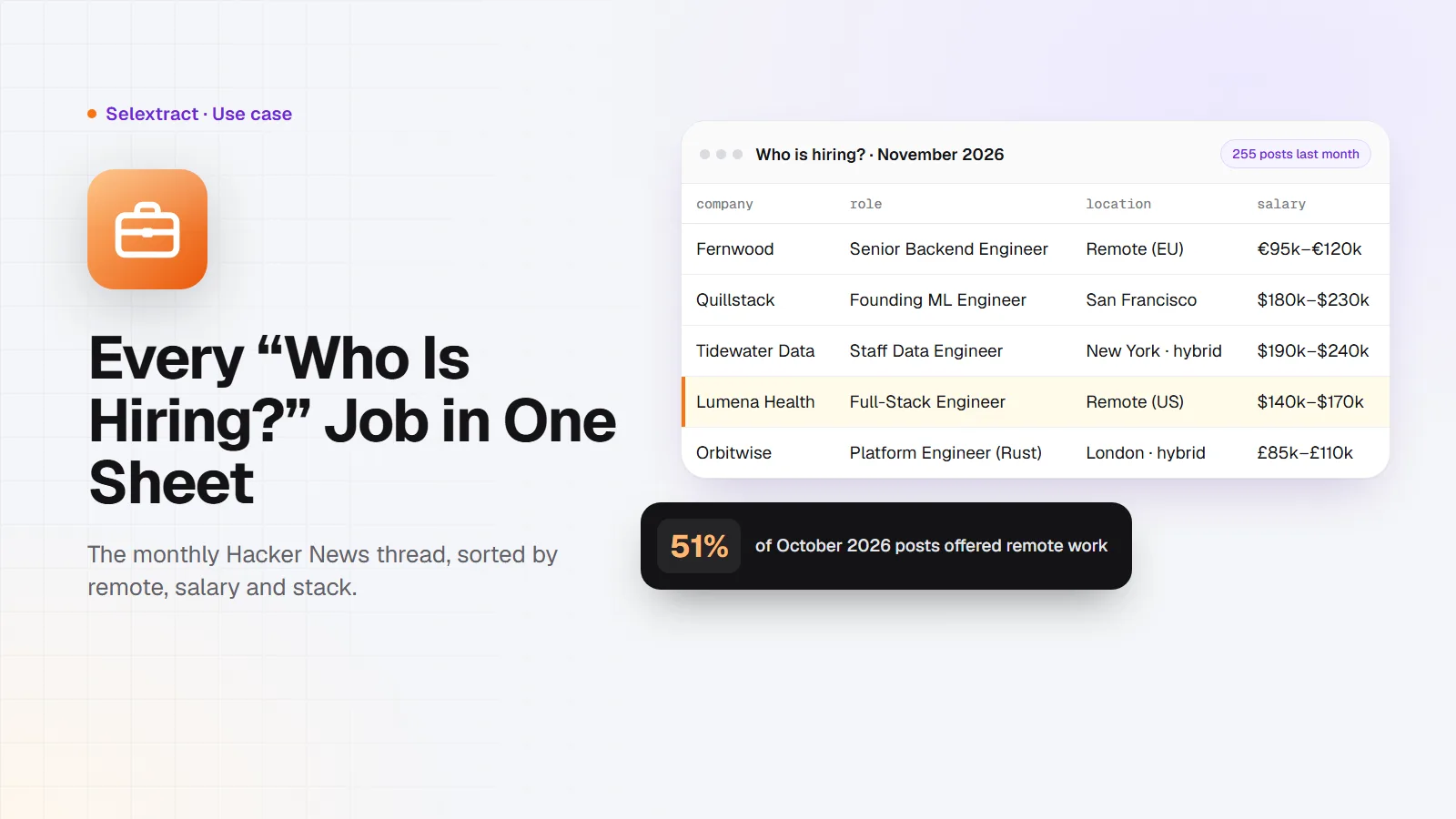
On the first weekday of every month, Hacker News opens a thread called "Ask HN: Who is hiring?". Hundreds of companies post a job in it, many of them startups that don't advertise anywhere else. The thread is great to read and hard to search: one long page, no filters, no way to sort. This post shows how to turn every job in it into one row of a spreadsheet, filtered to the jobs you care about.
What you need
- A Selextract account. The Hacker News Who's Hiring Scraper is ready-made, so there's nothing to build. Runs don't use AI; they run the same tested code every time.
- A spreadsheet: Google Sheets or Excel.
- Nothing else. You don't need a Hacker News account.
Step 1: Pull this month's jobs
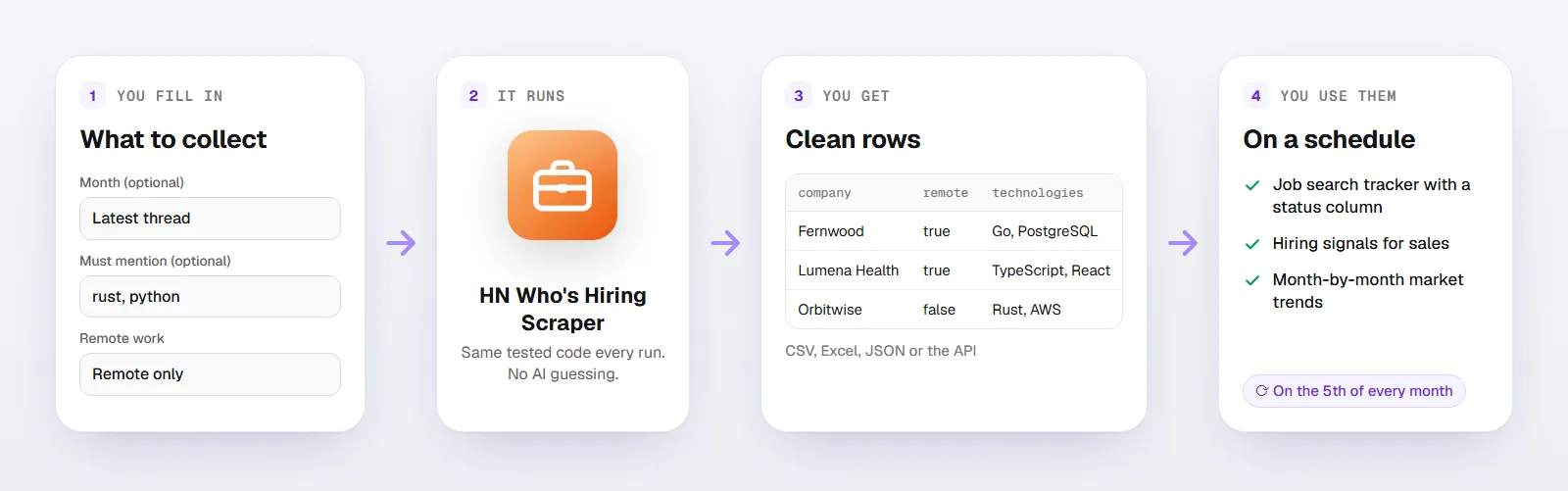
Open the scraper. Leave Month (optional) empty to get the latest thread, or enter a month like 2026-10. Leave the other fields as they are for the first run, so you see the whole thread.
You get one row per job post:
| Column | What it holds |
|---|---|
company, role, location |
Read from the post's first line, which usually looks like Company | Role | Location | REMOTE |
remote |
true when the post offers remote work, false when it's on-site, empty when it doesn't say |
salary |
The pay range as written, when the post gives one |
visa |
Whether the post offers or rules out visa sponsorship, when it says |
technologies |
Languages, frameworks, databases and clouds the post names |
links |
Links in the post, like the company's careers page |
headline, text |
The first line and the full post |
posted_at, post_url |
When it was posted, and the post on Hacker News |
thread |
The month, like November 2026 |
Posts follow a loose format, so company, role, location and salary are a best effort. When a value isn't clear, the field stays empty rather than guessed. The full text is always there.
Here's what a few rows look like. The companies are made up; the columns and formats are the real ones:
company |
role |
location |
remote |
salary |
technologies |
|---|---|---|---|---|---|
| Fernwood | Senior Backend Engineer | Berlin; EU | true | €95k–€120k | Go, PostgreSQL |
| Quillstack | Founding ML Engineer | San Francisco | false | $180k–$230k | Python, PyTorch |
| Orbitwise | Platform Engineer | London | (empty) | £85k–£110k | Rust, AWS |
Step 2: Narrow it down
Three filters cover most searches:
- Must mention (optional): words like
python,fintechorstaff. A post is kept when it mentions at least one of them. - Locations (optional): places like
LondonorBerlin. - Remote work: Remote only, or Not remote.
Then sort and filter in your spreadsheet. Two columns do most of the work: filter technologies for your stack and salary for non-empty values, and the list gets short fast.
What one month of hiring looks like
I counted the complete October 2026 thread. It had 255 job posts. Here's what they said:
| Posts | Share | |
|---|---|---|
| Offered remote work in the first line | 131 | 51% |
| On-site only | 66 | 26% |
| Mentioned hybrid | 43 | 17% |
| Gave a pay range | 73 | 29% |
| Mentioned AI, LLMs or machine learning | 143 | 56% |
| Mentioned visas | 17 | 7% |
The most named technologies were Python (61 posts), TypeScript (57), React (55), PostgreSQL (47), AWS (30), Kubernetes (26), Rust (22) and Go (20). In the first line, San Francisco and the Bay Area came up 44 times, New York 28, London 15 and Berlin 13.
Two things I'd take from that. Half of the jobs are open to remote work, so the thread is worth reading even if you don't live in a tech hub. And more than half of the companies mention AI, which says a lot about who is hiring right now.
Step 3: Use it for your job search
Make your spreadsheet your tracker:
- Add three columns:
status(to apply, applied, interview, no),dateandnotes. - Filter to your stack and location, and read the full
textof each match. Companies often say exactly what they're building and how to apply. - Apply through the links in the post, or the way the post asks you to.
Step 4: Not looking for a job?
The same table works for other people:
- Recruiters and agencies: the companies in the thread are hiring right now, many with small teams and no recruiter yet.
- Sales teams: a company hiring its first data engineer will need data tools. The
technologiescolumn tells you what they already use. - Analysts and writers: run past months, such as
2026-01through2026-10, and compare how remote work, pay ranges or AI mentions change over the year.
Step 5: Run it every month
The thread keeps growing for days after it opens. The November 2026 thread had 251 comments, posts and replies together, by its third day. Your run is saved as a task in your account, so schedule it for the 5th of every month with Month (optional) left empty, and once more mid-month if you want the late posts. Remove repeats by post_id when you combine runs.
If you'd rather work in code, you can start runs and fetch results through the API, or connect Selextract to an AI assistant through MCP and ask it to find this month's remote Rust jobs.
FAQ
When is the "Who is hiring?" thread posted?
On the first weekday of each month, by the Hacker News account whoishiring. Companies keep adding posts for the rest of the month.
Is there an API for Hacker News jobs?
Hacker News has an official API and a public search, but both return raw comments. The scraper finds the right thread, keeps only the job posts and splits each one into columns.
Can I get older months?
Yes. Enter the month you want, like 2019-03. The thread has run every month for more than a decade.
Does it include "Who wants to be hired?" or freelancer threads?
No. Only the job posts in "Who is hiring?", not the replies to them.
Why is a field empty?
The post didn't state it clearly. Companies write their first line in many ways, and the scraper leaves a field empty rather than guess.
Good to know
- One run returns up to 1,000 job posts from one month's thread.
- Usernames aren't included. Posts can contain contact details, so handle them according to privacy law, such as GDPR.
- Runs use your own Selextract credit.